


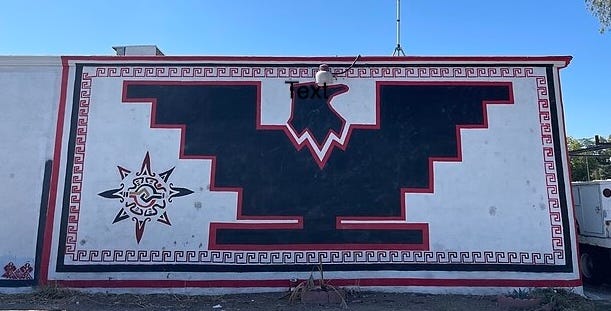
The first time I heard the name Cesar Chavez, I was 4 or 5 years old. My mother and grandmother were arguing about the value of participating in a boycott. I believe the food in question was grapes. (A quick Google search suggests I remember this correctly.) The argument was over whether my Grandmother refusing to buy grapes would actually make a difference to anyone. My grandfather was a Teamster, and we were a pro-union family. It didn’t matter how much her grandkids liked them, Mamaw would not be buying grapes at the store that day.
If you’ve ever been politically active in any way, you probably know the story of United Farm Workers and its leaders, Cesar Chavez and Delores Huerta. It’s an example used in just about every labor or political training I’ve ever taken or facilitated. In part because Marshall Ganz, a leading scholar, researcher, and training on social organizing movements spent years working alongside Chavez at UFW. The Sí se puede, the UFW motto, is so well-known that candidate Barack Obama made an English version of it, Yes we Can, the cornerstone of his primary night speech in New Hampshire, and one of his most-remembered viral videos.
So for anyone who has ever admired the work of United Farmworkers, Chavez, Huerta, and their fellow organizers, the New York Times story detailing that Cesar Chavez sexually assaulted and abused multiple women and girls over the course of his career, including Delores Huerta -- who publicly confirmed her abuse for the first time -- the news was devastating. The article was one horrific detail after another, confirmed by multiple sources. I can’t even imagine what it must feel like for the survivors.
America is a nation that doesn’t let the facts of history get in the way of a good story. (For better and for worse.) It’s one of the reasons our culture has been so dominant for so long. Stories are a powerful way for us to understand ourselves and our shared values. To pass those values from one generation to another. But we also whitewash and erase. We focus on tales of charismatic leaders (mostly, but not always, white and male) at the expense of everyone else in the room or in the fight. We erase the details that were less than flattering. We erase the people exploited and/or left behind.
In cases of abusive behavior, women are often called upon to bury the truth. We’re asked to ignore a man’s unacceptable behavior and focus instead on the good he’s done. We’re told that exposing abuse and corruption tarnishes not one man, but the entire movement/company/congregation/government around him. Huerta, in her public statement, acknowledges this reality and the lengths she went to keep her abuse a secret, saying. “I carried this secret for as long as I did because building the movement and securing farmworker rights was my life’s work. The formation of a union was the only vehicle to achieve and secure those rights, and I wasn’t going to let Cesar or anyone else get in the way.”
I hope that Huerta’s speaking out brings her peace and that she doesn’t face backlash for confirming details of her abuse publicly. I’m angry that she and her fellow survivors were abused in the first place and that they were compelled to stay silent. The New York Times interviewed 60 people for the story, suggesting that Chavez’s behavior was an open secret. For decades, countless people opted to protect Chavez over his victims, for the sake of the Farmworker movement.
Now that the myth has been punctured by truth, Chavez’s story is being rewritten in real time. Government agencies are covering statues of him while towns and cities race to rename public buildings and cancel celebrations honoring him. In Los Angeles, Janice Hahn, who sits on the LA County Board of Supervisors, has suggested renaming the upcoming public holiday Cesar Chavez Day to “Farmworker Day.”
I like Hahn’s suggestion. The story of the Farmworker movement shouldn’t be erased because of one man’s abusive behavior. It was never about just one person, or even a small circle of people. Only last week I wrote about highlighting the doers, and there are thousands of doers here, each with a story worth telling. As Delores Huerta said to close out her statement: “The Farmworker movement has always been bigger and far more important than any one individual. Cesar’s actions do not diminish the permanent improvements achieved for farmworkers with the help of thousands of people.”
America loves a good story, and the Farmworker movement story is one we should keep telling. One man’s abusive behavior doesn’t change what happened. But it’s time to let go of the neatly packaged myth and embrace a messier and more holistic version: one where thousands of farmworkers, over decades, stood together in solidarity and changed the fabric of America forever.
This story was brought to you by paid subscribers, who receive bonus content early. Because this one is timely, I’m making it available to everyone today. If you want to read more of my bonus content, consider joining my Patreon or hitting the big yellow button below.
Shocking story, thanks for publishing.
This one hurts…communally