



Content warning: sexual assault, online harassment
“Cornell Won’t, We Will.” With a recent editorial under that headline, a campus newspaper sent allegations of a 2024 group sexual assault at a fraternity rocketing to national attention. Charging Cornell with failing to keep students safe, editors named the defendants sued along with the university by an anonymous accuser — and condemned a lack of transparency about the outcome of a Title IX investigation opened into the alleged assault in early 2025. (The New York Times reports that campus police even omitted the accuser’s unequivocal declaration that she was raped from their account of the incident to local prosecutors.)
Coming nine years after the #MeToo moment of accountability for high-profile perpetrators of sexual assault, the Cornell allegations brought trauma back for many survivors of campus rape. They also sparked fury about a system that still seems stacked against survivors — a point driven home by efforts to dox the Cornell case’s Jane Doe plaintiff.
Why is accountability for campus rape still an uphill climb? One problem is the White House — which fits, given President Trump’s return to power after being found liable for sexual abuse by a civil court. Trump’s attempts to raze the federal Department of Education gutted its Office for Civil Rights (OCR), which oversees investigations of rape and sexual abuse at colleges and universities. In a March 2025 mass firing, OCR lost 299 people from its staff of 575 and shuttered seven of its 12 offices. The number of sexual violence cases resolved by OCR that year fell to zero.
The administration also declined to appeal after a federal judge tossed out Title IX enforcement rules written under former President Biden — opting instead to revert to enforcement regulations set during Trump’s first term. After the rollback, universities needed to act only on accusations of sexual misconduct within school programs directly reported to administrators — and official responses only needed to clear the bar of not being “clearly unreasonable.”
The return to pre-Biden regulations also brought back standards that required court-like proceedings in which survivors could face cross-examination by representatives of their alleged assaulters. The standards correspond with calls by men’s rights activists — a group of whom met with then-Education Secretary Betsy DeVos early in Trump’s first term — to level the playing field for students who faced accusations. (The official who then ran OCR said “90 percent” of allegations “fall into the category of ‘we were both drunk,’ ‘we broke up, and six months later I found myself under a Title IX investigation’” — but apologized after the quote made headlines.)
Less oversight, narrowed regulatory coverage, heavier procedural burdens on survivors who report sexual assaults: the reduction of options under Title IX, combined with a Roberts Court decision in 2022 that lower courts have interpreted to limit Title IX plaintiffs’ access to damages for emotional distress, has made getting accountability in campus sexual assault cases harder and more costly — both monetarily and emotionally — for survivors. As the suit filed by Cornell’s Jane Doe shows, survivors can still seek redress through the courts. That comes with a catch, however: the risk of exposure and targeting for public humiliation.
Enter the click-chasing gadfly Michael Tracey, who apparently seeks to regain whatever feeling he got from hectoring survivors of Jeffrey Epstein’s abuse at a press conference by trying to out the plaintiff in the Cornell group sexual-assault case.
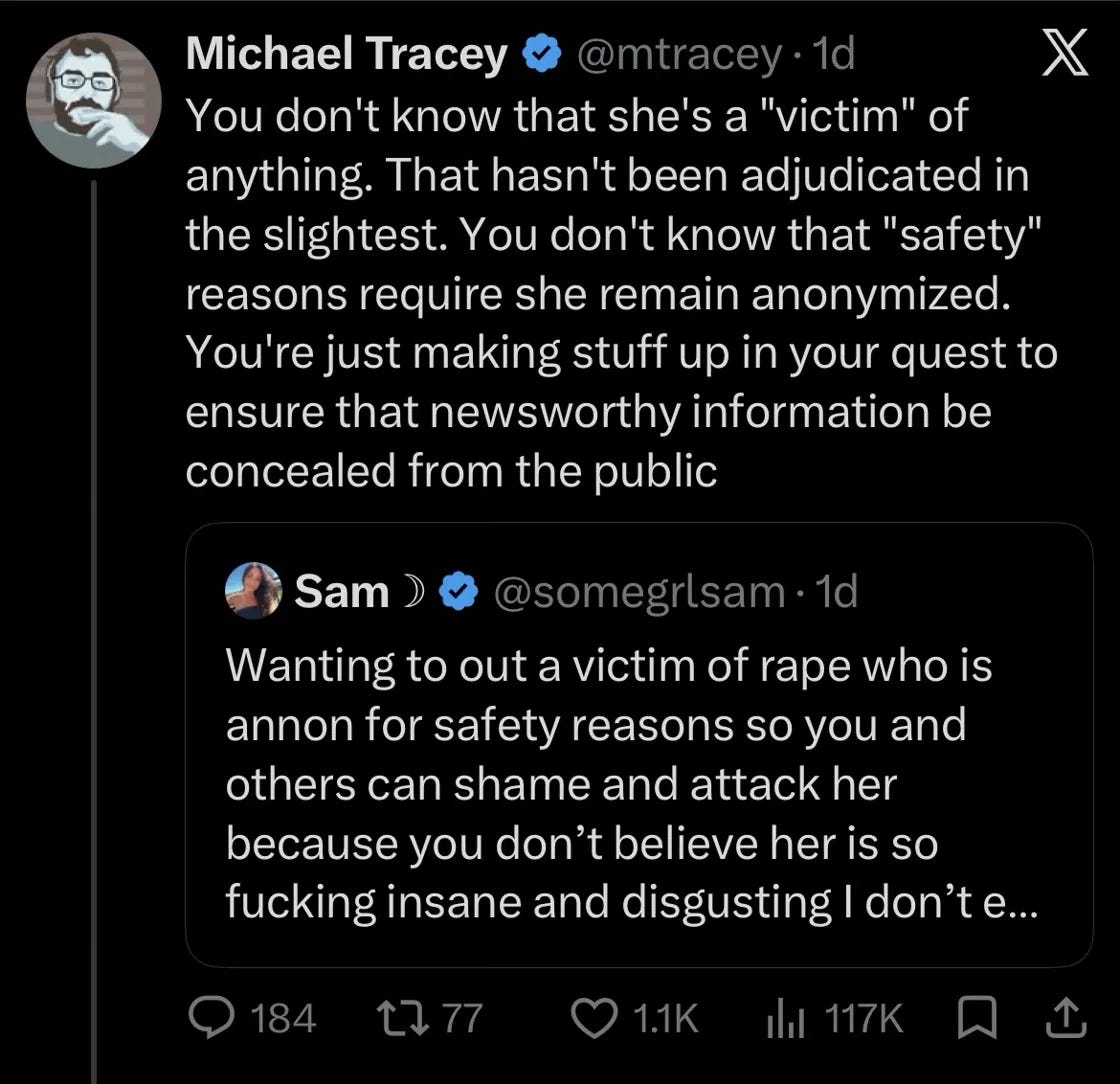
Tracey, like many X users, spent the past week rummaging for digital clues to Jane Doe’s identity. He also capitalized on the ensuing attention: posting clips to YouTube, shipping updates out through his newsletter, and making appearances on podcasts like that of white-nationalist-curious writer Richard Hanania, who called what happened at Cornell a matter of women who had “casual sex with men they don’t know well.” He added: “maybe she was assaulted, maybe not, either way it was a terrible decision to make.”
He means a terrible decision for the survivor to make, to be clear.
Here’s why Tracey’s survivor-outing stunt should trouble folks. One, granting anonymity to sexual assault victims is a well-established practice in professional journalism. A consensus that the identity of a survivor is “newsworthy information” just plain doesn’t exist.
Two, online platforms themselves have tilted against survivors since the #MeToo moment. Elon Musk, an on-again Trump ally whose views are at least manosphere-adjacent, now controls what was once Twitter. That site, which served as a hub of #MeToo activity, now has amateur sleuths darting through stray facts like schools of minnows — swarming over details about the possible hometown, school, or even name of the Cornell accuser with little apparent method or accuracy. (One swarm that sided with the accuser converged on a Marine mistakenly served with a copy of the complaint because he shared one alleged defendant’s name.)
Mobs can run roughshod over people’s privacy on X, as what remains of Twitter is now known, in part because Musk took a chainsaw to the platform’s trust-and-safety efforts. After buying the company, Musk dissolved its 100-member trust-and-safety council, made unsubstantiated insinuations about former trust-and-safety chief Yoel Roth that spawned threats and drove him from his home, and cut the number of engineers working on safety issues from 279 to 55. In the wake of Musk’s flamboyant disinvestment from trust and safety, other social media firms — including Meta, Snap, and TikTok — followed suit in making heavy cuts.
Three, incentives on Musk’s revamped X reward bids for engagement. Paid blue-check users who draw enough traffic to their posts — by, say, attempting to unmask a possible victim of sexual assault — can earn dollars for their content. X’s rules block users who post hate speech from its monetization program. How much the company enforces this bar, however, is open to doubt. Users presenting themselves as just asking questions about a campus rape seem to have little stopping them, for now, from sharing speculation at young people’s expense.
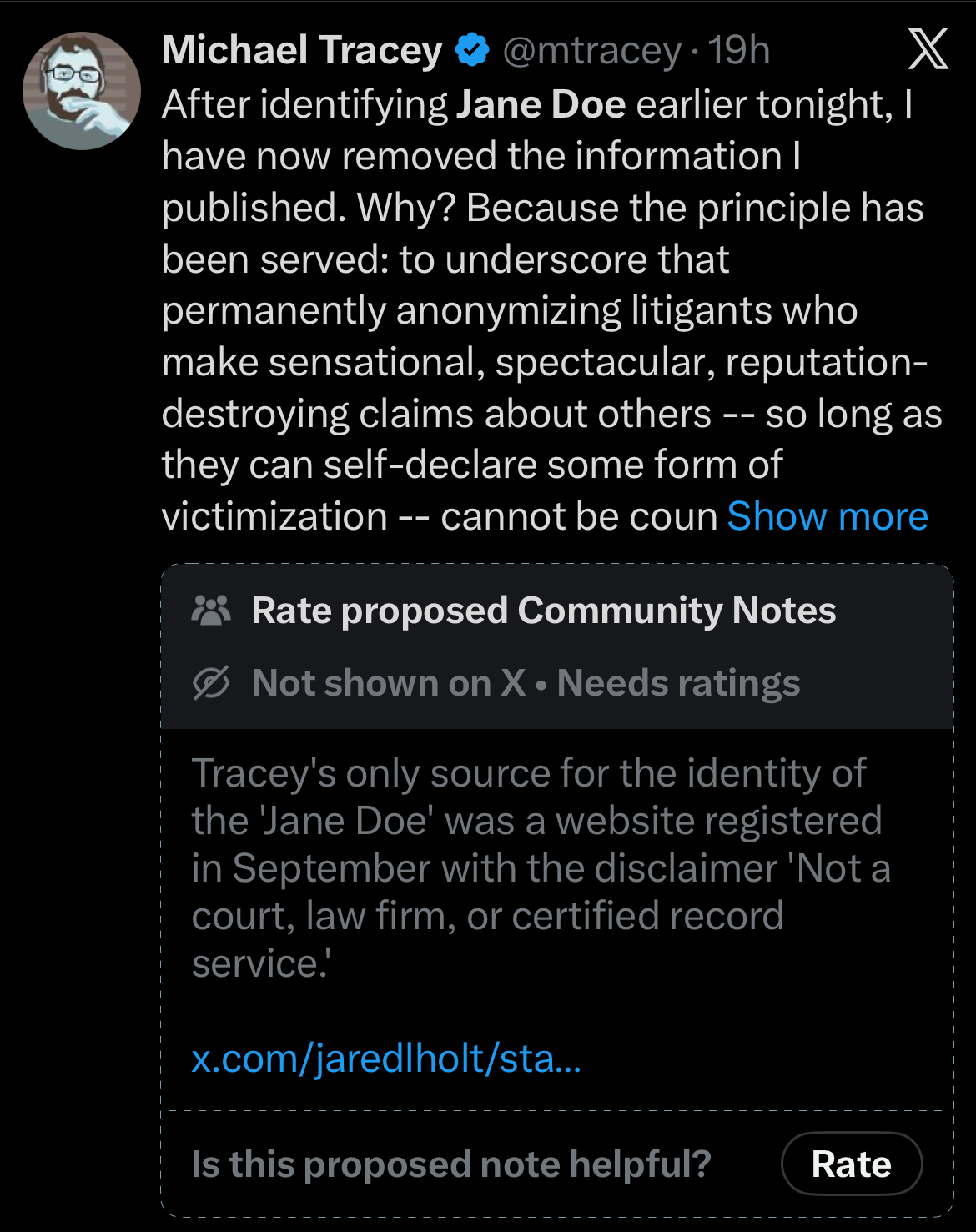
That explains why X was overtaken this week by users playing private investigator on a ghoulish pretext. The site’s incentives are working just as designed.
New York state officials swung into action as controversy around Cornell’s handling of the case built; state governor Kathy Hochul announced on Thursday that New York attorney general Letitia James — long treated as a nemesis by President Trump — would lead a criminal investigation. As if to put words to the shrugging response that campus rape survivors still face, President Trump reacted to James’s appointment by condemning her: “I feel badly for whoever she’s looking at, because they won’t get a fair shake.”
If they do get a fair shake, that’ll be more than Cornell’s Jane Doe got this week.
ICYMI
The Bizarre AI Ad Trying to Make an Extremist Candidate Look Like Jesus (Talking Points Memo)
Key Election Denial Activists in the Right-Wing Media Ecosystem (Media Matters)
A Safer Internet Should Not Come with Democratic Shortcuts (Tech Policy
Press)
If you’d like to contribute to Ctrl Alt-Right Delete, ActBlue makes it easy to chip in. Your contributions help Melissa keep the newsletter free and available to everyone, and take much-needed time off during her cancer treatment.
If you’ve saved your payment information with ActBlue Express, your donation will go through immediately:
Coda
Happy to fill in for my good friend this week — Melissa’s doing well after her surgery, even laughing at my word count (which has come in slightly longer than her usual). Next week another old friend, Pam Spaulding, has the pen; I can’t wait to see what she has in store.
As for my thoughts on the folks I devoted this issue to, I think OG riot grrl Kathleen Hanna, of Bikini Kill — the band shown performing here at this summer’s Daisy Chain Fields Festival in Irvine, Calif. — sums those up.
Thanks for reading, y’all, and keep sending Melissa your thoughts and good vibes.
