


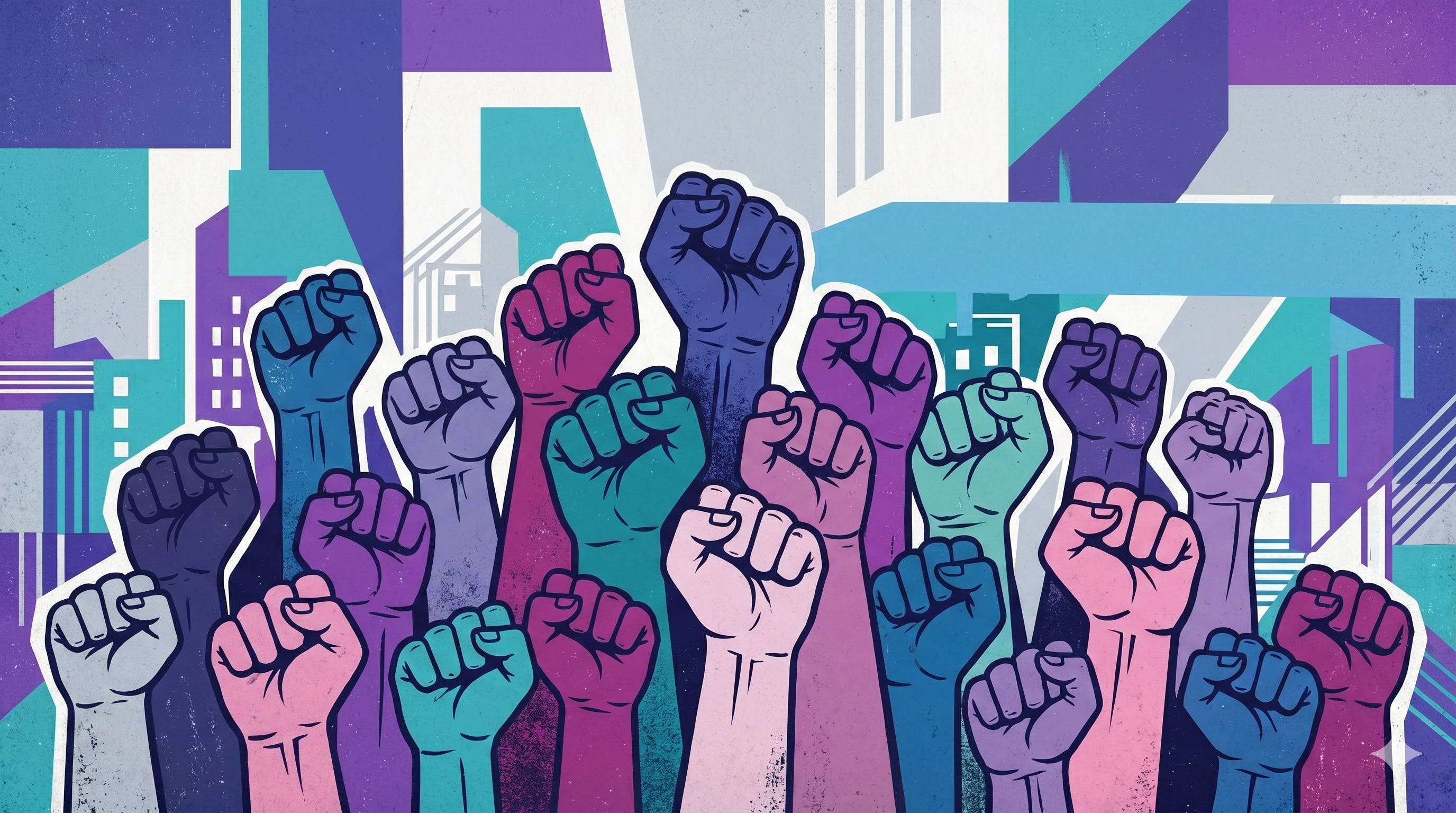
Stop telling me to vote harder is a sentiment I hear from readers and see online fairly often. I understand it, and I feel it too. After Trump’s win in 2016, Democrats won several subsequent elections and special elections. And yet 10 years later, we find ourselves here again. With a Trump 2.0 that’s objectively more destructive than his first term in office, on a scale so vast it’s difficult to quantify.
The majority of Americans don’t want to live in a dystopian hellscape (something I still believe), and yet here we are. A competitive authoritarian system where the worst people you could dream up are tearing our country apart piece by piece, all while enriching themselves at every opportunity.
And still vote harder remains at the center of the conversation. Especially from elected officials and the organizations set up to win campaigns. Even in pro-democracy spaces. I’m guilty of it myself! And yet, as many of you have pointed out to me, that message is going out to an audience who did exactly that. Repeatedly.
I hear you, and I feel your frustration. Which is why I’ve been on a mission to find different ways to fight back and deepen engagement. I’ve worked to find the doers, especially folks doing innovative things that can inspire action in other communities.
Earlier this year I asked readers for examples of how they were organizing in their local communities and y’all came back to me with some incredible stories. Some came from Minnesota, where the state’s twin cities were essentially being occupied by ICE, but I heard from folks all over. Anecdotes included efforts for rapid response, mutual aid, educating one another politically, and working with vulnerable communities to ensure they were protected. Since then, I’ve been on a deep dive to learn more about anything and everything people are doing in their own communities to fight back.
The best definition for this kind of activity I’ve seen is community defense. Local and hyper-local efforts for neighbors to protect and defend one another, outside of the typical organizations we’ve built for advocacy and services. It’s a broad term that includes actions that are more traditionally political, such as pressuring elected officials or election protection, as well as actions that are apolitical, like mutual aid or documenting ICE activity and rights violations in a community. Minnesota is the best-known example of community defense in action, but there are efforts underway everywhere. Since folks are self-organizing and working outside traditional structures, it’s hard to quantify just how much is happening. But my sense, and that of experts I’ve talked to, is that there’s a growing movement of community defense efforts in communities large and small.
This week, I did a livestream with Jill Garvey, a co-founder and co-director of States at the Core. STAC is a newer organization that supports local community defense efforts. They hold frequent public trainings, which I highly recommend if you want to learn more about how to join or start community defense efforts where you live. Our full conversation is worth watching.
A couple of important takeaways: first is that when it comes to elections, the answer isn’t vote harder, but yes and. We already know that the Trump Regime doesn’t want elections to be free and fair, and that the Supreme Court has empowered them to take steps towards that end. But we also know that in the US, elections are run locally, so in addition to voting, it’s on all of us to do everything we can to ensure elections are free and fair in our communities. By protecting not just our vote, but the right of our more vulnerable neighbors to vote and have their voices heard, too.
The other big takeaway is the importance of documentation and storytelling. Minnesota inspired folks all over the country to step up and get involved. Jill told me that more than 50,000 Americans have attended a STAC training, and that she believes potentially millions of Americans are engaged in some kind of community defense activity. There’s a balance of keeping people safe and not exposing vulnerable communities to even more risk, but we also need more people to join the fight. And nothing will inspire others like stories of what ordinary people are doing every day to fight back with their neighbors and friends. We keep us safe, and as Jill points out, the more people join in the fight, the safer we’ll all be.
Thinking about resistance at a large scale, especially the often touted 3.5% rule, community defense is a key piece of that puzzle. Self-organized groups that trust one another and have built trust with a larger network where they live can accomplish a lot. I’ve long thought we don’t have the infrastructure we need to fight the Trump Regime and the MAGA Right, but as I learn more about community defense, I’m realizing that a new infrastructure is being built all around us. A decentralized network of citizens who are fed up with how things are, unhappy with what’s been offered by the opposition, and willing to step up to do things in a new way. The possibilities are limitless.
Next month, STAC is holding a series of four virtual trainings: Smash Authoritarianism Summer Camp. Over the course of a week, the camp will cover everything you need to know about community defense. It’s a crash course in community defense that will include both up-front presentation and breakout ask-me-anything sessions with experienced organizers. I encourage CARD readers to sign up and attend one or more sessions. I’ll certainly be there.
I’m still learning as I go, so if you have a story about community defense that I should know about or someone I should talk to, please hit me up. You can reply directly to this email or leave a comment.
The Ask
CARD is once again an independent operation, and I have some big plans ahead, including:
Moving off of Substack next month
More livestreams
A new website.
To keep the newsletter going, I need to raise $15,000 between now and December. Currently, we’ve raised $2,805.00 towards my goal. A solid start, but we still have a long way to go. Can you chip in with a one-time or recurring contribution on ActBlue?
If you’ve saved your payment information with ActBlue Express, your donation will go through immediately:
If you’re already subscribed, donated, or you’re a Patron, thank you. Your contributions help keep the newsletter free for everyone. I want to make this content available to as large an audience as possible, and I’m so grateful for your help and support.
And if you want to sponsor the newsletter, advertise, or partner in some way. Hit me up.
ICYMI
Your Values Are Nothing If They Aren’t Tested This essay from Ijeoma Oluo -- about where movements fall short and the importance of living your values even when it’s a challenge -- has stayed with me ever since I read it a week ago. A meditation on where we fail and what to do about it.
White House Seeks Federal Spending Data On Dozens Of Nonprofit Organizations (Federal News Network) Another brazen weaponization of the Federal government to punish Trump’s political enemies.
NAACP Calls for Black Student-athletes to Boycott Southern Schools Amid Redistricting Backlash (NBC News) I’m following this story closely. Because I hope it has legs, and because I have a lot of faith in young people generally.
Coda
That’s all for now. No newsletter next week as I’ll be in Philadelphia for Netroots Nation. If you’re attending, be sure to catch the keynote panel I’m moderating on Friday evening. Featuring three progressive fighters in Congress: Rep. Delia Ramirez, Rep. Summer Lee, and Ana Lilia Mejia.
I’ll be back to it on Sunday, June 14!