


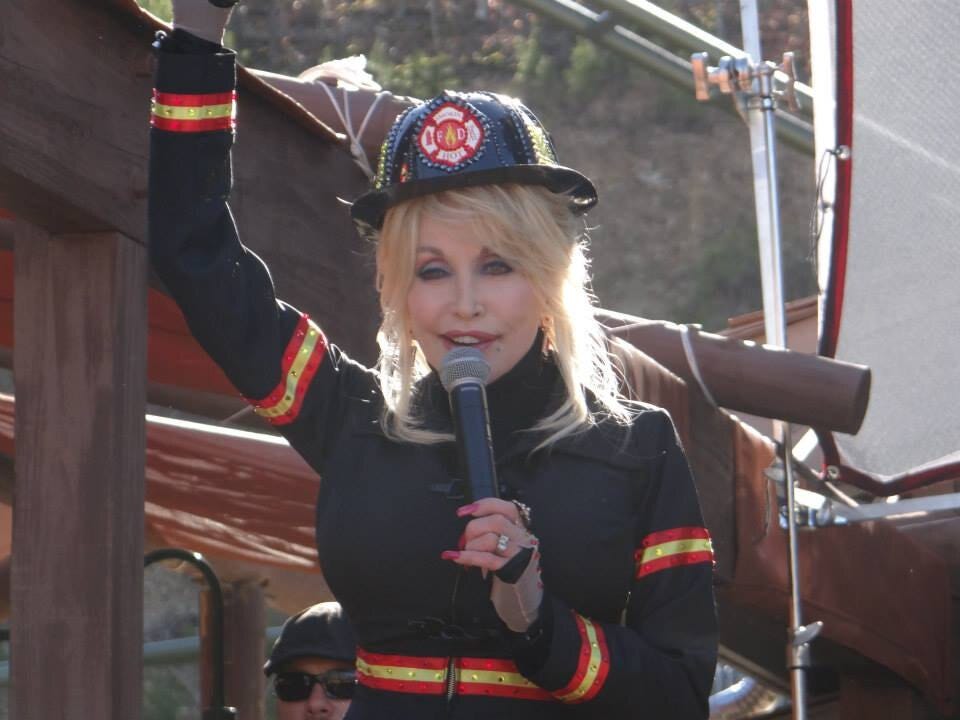

Dolly Parton’s music and persona have always been intertwined in my life, and I have countless memories of her music. I could write an entire essay about what Dolly meant to me personally, but as I watched the entire Internet grieve her yesterday, I realized there’s not much original or unique I can say about what she meant to me. So many of us are feeling it, and I loved all the stories and anecdotes I read online.
One of my favorite aspects was all the stories about Parton that circulated and how even her fans learned new things about her. Maybe you learned about a song of hers you didn’t know about or a TV clip you hadn’t seen. But most of what was shared was about who Dolly was as a person, her Imagination Library, and stories about how she showed up for vulnerable people and communities.
Everyone loved Dolly Parton. I was struck by this skeet on Bluesky from Huck Mason, pointing out that both Donald Trump and Democratic Socialists of America had both posted glowing tributes. The first and only time they would ever agree on anything.
Writer Garrett M. Graff’s skeet about Dolly also resonated with me, probably because I’ve been putting together notes for a future piece about Charlie Kirk’s assassination and the Internet’s reaction to it.
Don’t worry, I’m not going to compare Dolly Parton to Charlie Kirk, but I do want to talk about Dolly Parton and politics. Because I’ve always admired how she chose to express her political views and the moments she chose to speak up. Some believe Parton was apolitical, which is something she cultivated. She loved all of her fans, and wanted them to feel loved rather than judged by her. That includes her right-wing fans. But she also stood by people and stood up for vulnerable people repeatedly when it counted. Here’s what you need to know:
Dolly lived her values
“And of course Black lives matter. Do we think our little white asses are the only ones that matter? No!”
Dolly Parton never endorsed a candidate or a political position. She’d never say a bad word about anyone. But she also didn’t stay silent, and she made clear her positions were based on her faith and her values. Parton unequivically stood with Black Lives Matter when asked in an interview and not just in the moment; The Root chronicles her record of supporting the Black community, including in her home state of Tennessee.
And I probably don’t need to tell you about her continued support for the LGBTQ+ community, and unabashed love for her LGBTQ fans. Dolly loved drag performers, and more than once said that were she a man she would surely be a drag queen herself.
My personal favorite Parton song is Travelin’ Thru, which Parton wrote for the movie Trans America. The song is universal in its lyrics and has gotten me through many a tough time in my life (including in recent weeks), but it’s also a metaphor for transitioning as a resurrection. Dolly sings:
God made me for a reason and nothin’ is in vain
Redemption comes in many shapes with many kinds of pain
Oh, sweet Jesus, if you’re listenin’, keep me ever close to you
As I’m stumblin’, tumblin’, wanderin’, as I’m travelin’ through
Dolly spoke out for Trans folks too, as recently as 2023 against anti-Trans legislation in her home state of Tennessee, but Travelin’ Thru was from a movie released in 2006. Her values are rooted in her Christian faith, something the song makes clear. Love everyone, and let them know they belong. Judge no one because that’s God’s job. Political fights come and go, but faith is eternal. And it’s always time to do the right thing.
Dolly showed us who she was in her deeds and words
Parton was a lyrical genius, and she told us who she was and what she believed countless times in her songs. But she also understood the concept of deeds over words. She’s probably most known for her Imagination Library, which sent a free book a month to kids all over the country, including my own, from birth to age 5.
We have many of those books in our home, and those books are meant to take a beating from children who read them over and over again. Anyone who has small children can tell you that loved books are battered books, but Imagination Library books are sturdy, made of tougher stuff, clearly designed to withstand toddlers for a long period of time. I’ve always assumed that choice was intentional. Dolly could have sent cheaply made books and everyone still would have loved her for it. Those books are made with respect for the children who would read them.
We also have Dolly Parton to thank in part for the Covid vaccine. Thanks to a $1million donation she made proactively at the start of the pandemic. She called up a doctor who was a friend of hers and asked how she could help before anyone had a chance to ask. Then she helped promote the vaccine by changing the lyrics to Jolene and getting her shot on a video for social media.
And Dolly never forgot where she came from. Many of her philanthropic efforts benefited Sevier County, where she came from, and her home state of Tennessee, and her Dollywood Theme Park created jobs and economic opportunity in the region. A Dollywood foundation focused on local aid, and Dollywood paid 100% of college tuition for its employees.
Dolly understood politics was downstream of culture
A lot is being written today about Dolly Parton being apolitical. She worked hard to cultivate that image. But I have a different interpretation of her advocacy. Dolly knew that her power came from the culture, the Appalachian culture that she came from, and the culture that embraced her music and persona wholeheartedly. She intentionally curated her stances and chose her words (and lyrics!) carefully.
Tressie McMillan Cottom wrote the definitive essay on Dolly and American culture in 2021, and it’s worth a read in full, but this passage in particular really illustrates the point:
“All of my reading also revealed this: Dolly Parton is one of very few living texts that could survive projections of America’s soul without buckling beneath its contradictions. It is treasonous to do so but if one strips away all the adulation, they are left with an odd totem for our socio-political times. Dolly is a white Southern multi-millionaire boomer who produces self-consciously white music while wearing a stylized drag of a fallen Southern belle. Only a society that willfully believes itself “post-racist” could produce such a queen. Post-racist does not mean there is no more racism. It means that we believe there is an us after we rid ourselves of our errant racist bones, which we are certain will come to pass. We craft Dolly into an unproblematic fave because the most problematic part of The Dolly Parton Moment is us.”
None of this is by accident. Dolly Parton knew who she was, and what she wanted to project out to the world. She knew what her power was and where she could make the most impact. It isn’t politics the way most people think about politics in our hyper-partisan era, but Dolly’s use of music and culture was absolutely a political act.
Dolly never forgot where she came from. And she could still evolve
“As soon as you realize that [something] is a problem, you should fix it. Don’t be a dumbass’.”
I feel a personal kinship with Dolly because we both come from the same overarching Appalachian/Southern culture. She was a country music singer, and I am an unabashed country music fan. Of course, loving country music is complicated, especially right now when the American Right continually attempts to claim ownership. Country music’s history also includes appropriation and wholesale theft. Country music doesn’t exist without Black music, but much of the industry seems determined to exclude Black voices and artists from the genre.
Because of this, loving country music, and really loving anything about Southern culture, is complex and often uneasy. It’s something I feel as a music fan and as a Kentuckian. I’m proud of my working-class roots and how they’ve shaped my politics and values. I’m also well aware of the harm my culture and my ancestors have inflicted. Both things can be true.
After Charlottesville in 2017, Dolly Parton found herself dealing with these issues directly. She was criticized, fairly, for the name of her themed restaurant, Dolly’s Dixie Stampede, and for what both the name and her Civil War-themed dinner theater show evoked. The Slate article from a writer who saw the show twice describes how tone deaf and racist the experience was, and reading it again, it’s hard to reconcile the Dolly Parton who owned that restaurant with the Dolly persona we’re all mourning right now.
But here’s the thing: Dolly Parton evolved. Instead of getting defensive about the essay, she removed Dixie from the name and overhauled the show. She didn’t blame antifa, or claim both sides, or any of the rhetoric that was common at the time. When asked about the change, Dolly said, “When they said ‘Dixie’ was an offensive word, I thought, ‘Well, I don’t want to offend anybody. This is a business. We’ll just call it The Stampede. As soon as you realize that [something] is a problem, you should fix it. Don’t be a dumbass.”
Dolly Parton wasn’t perfect. She made mistakes just like the rest of us, and she probably came up short more often than she wanted to. She didn’t practice politics in the way that I do or the way most of my readers choose to engage. But I admire the way she did. And it’s one of the things I’ll miss most about her.
We’re incredibly close to hitting my goal of raising $15,000 on ActBlue by the end of the year (89.61% to be precise). Will you help put us over the top by making your contribution today?
If you’ve saved your payment information with ActBlue Express, your donation will go through immediately:
What a terrible couple of days it's been for losing the wrong eighty-year-old. Take good care, Melissa. 🫶🏻
Could there be any greater contrast between real achievement and basic human goodness than the Queen of Country and the man who thinks he’s a king??